Friday, 15 November 2013

CREATIVE MEDIA PRACTICE: FINAL THOUGHTS AND REFLECTIONS

Some weeks after finishing 'The Beer' here are a summaration and collection of thoughts I had about the final project.
  • The feedback I have recieved from it by sharing the video on social media has been positive - many seem to have gotten the experience and enjoyed it in a way I imagined and hoped they would. The views on the first video (the true indication of how people watched it) have also reached 100 - which for me of my reputation on YouTube is very good.
  • I'm particularly proud of what I achieved by myself. Compared to what I achieved with my last YouTube annotation video I felt I fully explored the uses of annotations and feel like I created an expereince that uses them in an engaging and unique way.
  • On watching back I would like to make the experience larger - I would achieve this by adding more clues and more 'rooms' for the audience to explore. The idea of also including more potential suspects is something else I would look to add.
  • I would have liked to improve the production quality of the project. Issues with booking meant that the professional lighting rig we had booked was not avaliable for us when we came to film the project meaning we had to make do with room lighting. Whilst it isn't too much of a distraction there were better options avaliable that I wished I had explored.
  • On some of the shots I had to get in a second camera man to help out whilst I either sorted out the lighting or to focus on directing. Whilst I was a fan of some of his camera work, there were some inconsistancies between his style of camera work and my own. One of these was his use of pull focus which led to some of the shots being out of focus. If I was to do this again I would keep one consistent camera man - whether it be myself or someone else - to have a distinguished look to the film.
  • Actors were also hard to come by and I used a lot of friends to be in this project. Whilst their attempts were valiant and I was appreciative of what they did for me - if I could have got in contact with actors and actresses who were comfortable to perform this could have improved the final product.
  • One of the most interesting thing to note is the amount each views the videos get. As noted before, we recieved a 100 clicks on the first but interestingly the definitive end video has only reached 30 views. I would like to look into whether this was due to people losing interest in the story and if so how could I improve it.

In conclusion, whilst I accept on a production level there were obvious flaws with 'The Beer' in terms of exploration and reflecting on what I created I was satisfied. I felt I made exactly what I set out to do and this is something I would definitely be interested in looking into again - I have already made plans for a possible sequel or entirally different YouTube annotation video with hope to explore new different and unique possibilities!

CREATIVE MEDIA PRACTICE: THE FINAL PROJECT


CREATIVE MEDIA PRACTICE: Project Development

With the narrative already in place, just with some minor adjustments and tweaks, I decided that my next point of call would be to find some new and varied inspiration for my project.

One of the initial videos I found was Christopher Bingham's (aka slomozovo) 'B.R.O.X.' - an unfinished project he released some point last year.


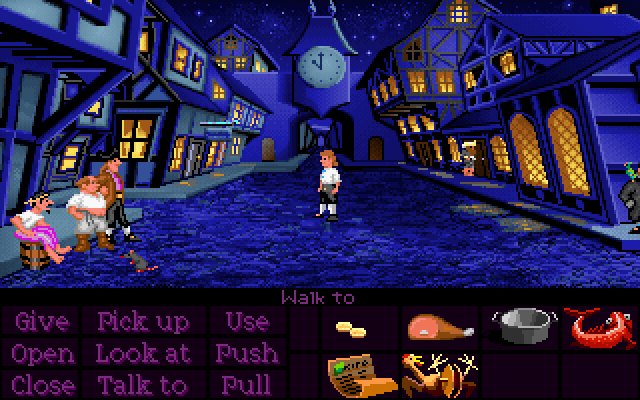
 This grabbed my attention immediately as it was exactly what I wanted to create. This idea of using annotations he created a small world for his viewers to interact with. This reminded me very much of PC Games, such as the Monkey Island series of games in which viewers would point and click around a world finding things to interact with to find clues and information on how to progress.


With this in mind I started to adapt the script. I envisaged there being two 'main' screens of this video in being the Living Room and Kitchen in which both these rooms the viewer could click on various objects or people to gather clues. I also created a 'web' in a notebook of how I would envisage linking the videos together.
 

AN EXAMPLE OF A 'MAP'
 
I had to make sure that each video had a way of linking back to one of the main screens and also this map made it easier for programming the annotations when it came to uploading them.
 

The filming took a good part of a day with me directing the shoot with someone on hand to take camera duties if I needed help. Editting and uploading the video was also undertaken by me entirally. 


CREATIVE MEDIA PRACTICE: The Final Project Outline

After exploring all the different posibilities CMP had to offer it was time to pick one area to explore in particular. For me it was a choice between either triptychs and YouTube annotations. These were the two areas I felt like I was most interested in and that I had most interest in explore when I did. What was my final deciding factor was what I felt most satisfied in what I explored. This, as I had established in my previous blogs, meant that I would pick to do a YouTube annotation video.

As said before, I felt a bit fustrated at the lack of ambition I felt I showed myself after making my previous video after realising the full potential of annotations. I wanted to really create a story that the audience could interact with. Something that was a bit more complicated and less simple as what I did previously.

For a long while I've been part of a YouTube channel called 'SpaceCat', along with a few friends off this course and Film Studies. On this channel we create short sketches and little films. One of scripts I had written for it was called 'The Beer' in which the story is that one of the characters loses one of his beers and decides to interrogate all the characters in an overly intense manner. This sketch was initially filmed but due to a variety of reasons never got released. I decided that this script would be perfect for a story as not only could I develop the 'interview' idea shown previously in 'Washing Up' I could try to incorporate scenes where the protagonist could look for clues and the like.

CREATIVE MEDIA PRACTICE: YOUTUBE ANNOTATION

Before I start I must say one thing: I love YouTube.

I love it as a fan, I love it as a media student and I love it for what it stands for as a platform. It gives so much in terms of procastination, inspiration and the hope that I can make someone and broadcast it to potentially millions is something I find fantastic.

The other thing I'm a fan of is interaction - giving the audience the chance to become involved or even in control of a story is someone that excites me and in this day of media with the technology we have avaliable to us is something that is getting more possible every day.

The fact in this module I had the chance to explore both of these things coming together was a dream to me.

YouTube Annotations are, in short, a link that can be programmed into the video player. They have been used in many different ways from what I have seen. They can be used as links to other videos, advertisments to other channels or even a means of way to subscribe. This creates an easy way of navigating the network systems which most 'YouTubers' like to do. In the past the audience would have to scroll down and try to find the links in the small and complication 'info box' which may have previously been lost in a variety of text and mass of hyperlinks but now with annotations there was now a simple and easy way to do this.

The other possibility created through annotations was the interactive video. This is something I wanted to look into the most. My main source of inspiration came from the works of 'WheezyWaiter', a YouTube comedy blogger who often dabbles in multi choice adventure videos from time to time.

 
From this me, Josie Webster and Ian Gardner ("Why's it alway us three?") decided to do something similar about an issue that reigns supreme in our flat: washing up.

 
We decided to make a short interactive video in which the viewers aim is to try and get my character out of doing the washing up. We were quite proud of what we did for a first time effort but looking back there were many things that I wasn't happy about. For me it was too simple and that the idea of 'multi choice' wasn't really that obvious as the viewer was forced to go down one particular path. I also felt upon realising how easy it was to make one how much more complicated and expansive we could make the experience. It was these doubts that played a great influence in me picking my final project.

CREATIVE MEDIA PRACTICE: QR CODES

QR Codes was the only lecture I missed in CMP - so I will instead use this time to discuss my overall experience of QR Codes in this blog.

QR Codes are vastly becoming one of the best ways for companies to advertise or promote their products. QR in short is 'Quick Response'. The idea was first developed in Japanese car manufacturing as a mean to track vechiles production progress. Now, only recently, companies are using them as ways of reaching out to their intended markets. Using the technology of the smart phone which can recognise and read QR Codes which can link to sites allowing more information about or even where to buy the product in question. Perhaps the most bizarre example of them being used is where some people are even using QR Codes on gravestones to allow passerbys to gain more information about the deceased person their walking past.
I have used and explored QR codes in the past year of University in a similar module. We had to create an interactive media based story for a wide audience which used a range of different media elements. Myself, Mark Nugent and Ian Garder made a story where our reader started recieving messages from the future warning them about a politician called John Place who was only then a canidate but in the future becomes an evil tyrant who in the future brings about nuclear warfare.

One of the interactive elements was QR Codes. As part of our presentation we said we would place QR codes around Britains major cities (London, Edinburgh, Liverpool, Manchester, Cardiff etc.) near key important locations showing them in the future to portray the dispotian horror of it all.

I found working with QR Codes there was a great sense of limitation. It was a handy and 'cool' way of sharing links but it was the content of the links that overshadowed the QR Code. They are by all means important today, however, and actually it was from working with them that inspired me to download a QR Code reader for my own phone to explore when I find them today.

CREATIVE MEDIA PRACTICE: ISADORA

Isadora for me was the one programme in particular that I looked at in this module that both excited me and infuriated me.

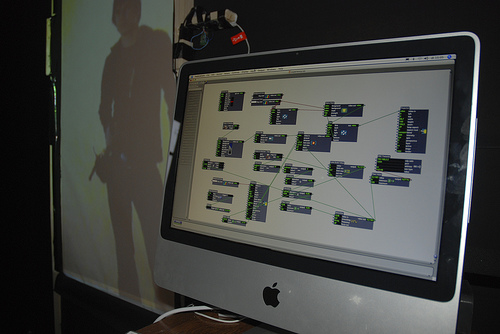
Isadora was created by Mark Coniglio. It's initial purpose was to enhance the performances of Troika Ranch, a media interactive dance company he was associated with. Isadora, according to its own site, is 'easy, flexiable, reliable and powerful'. It's an extensive programme that allows a wide range of inputs from its audience, from a simple mouse click to voice control and even motion, to create a truly awe-inspiring media experience.


We were set the task of creating an interactive media experience set around the theme of Halloween. Having just been introduced to Isadora that day and being told of its almost unlimitless possibilities did, in short, blow my small, Welsh mind initially. Normally I like to know the constraints of a project so I know my limits, however being told I could do everything with anything instead of expanding my creative horizons brought to a crushing thud. I was a bit overwhelmed. Members of my team were suggesting ideas and I had no idea if they were possible or impossible or what I could add or what we should take away.

Plus then there's the 'easy, flexiable and reliable' programming that comes with Isadora.

 
For someone who admittenly isn't much with programming the maze Isadora's presents you again frazzled me. In the end I was resorting to following the little red paths you create like a 5 year old with a 'follow the snail trail' game in a childrens magazine. We made a product eventually that I was proud with, but I felt personally coming out of Isadora that I was never in control of anything.

However, I don't want to appear like I hated or didn't appreciate Isadora. As someone who is a fan of allowing audience interaction I could see the benefits of Isadora in so many ways. I think I would need more time and experience of the product to gain a full benefit. This was a case of a kid being given the keys to a Ferrari when he had only recently passed his driving test. A surreal analogy, but one that I feel would suffice for explaining my relationship with this product.

CREATIVE MEDIA PRACTICE: THE TRIPTYCH

The first of the concepts we were introduced to in Creative Media Practice was triptych. Triptych is the exploration of split screen presentation in film. The most common way of presenting or viewing film and movie is in one standard screen frame. With triptych, there is a exploration of the 'multi screen' thought process. This arguably allows for more expression and allows the viewer to become more submersed in the film.

Triptychs as a concept has been around since early paintings. They were mostly used in Catholic Churches as decorations for altars, deciptating scenes from the Bible, such as the one here:


There are many advantages to using triptychs. They can offer different view points on one situtation at one time - or they can show three completely different images which all convey the same message. It's an interesting and complex way of getting the artists intended message across to their audience.

Myself, Ian Gardner and Josie Webster all set about exploring this format in our own way in the form of a short film. At first, I think the initial feeling of possibility overwhelmed us when it came to discussing our initial idea's. Our brain storming session went from our film being an exploration of a location in Liverpool (mainly Bold Street) to a complex story about two flatmates who mistake the other person for a burglar. Both this idea's failed on the fact that they were too complicated and large to film in our production time bracket. What we instead lumped for was a simple idea of showing the process of someone waking up and going to University:

"In The Morning": http://www.youtube.com/watch?v=w431iv23FsA

Here we played with the simple idea of showing one narrative through many different perspectives. One of the best examples of how we did this was in the bathroom scene in which one screen you see the protagonist washing his hands and then his teeth, whilst the other one is a close up on him preparing the tooth brush and the other one is him switching on the taps. Two of the screens were giving context to the other at one point which I found an interesting notion. Another aspect I liked was the idea of timing the screens to come into time with the beat of the song - something which I felt made the video more exciting visually.

Friday, 8 March 2013

Here We Are Again... Year Review 2012/2013

I swear I promised at one point I would blog more.

Me and blogging have not gone in hand in my time at University. This is bad and I need to reticfy this. I need to understand the importance of it in my ambitions to work in the media. Then again - I also need to lose weight and I'm currently chewing on a Mars Bar. Here's to 2014!

DIGITAL MEDIA CULTURES

One of the modules I seemed to embrace the most as this most reminded me of my days in A-Level Media. Not on an intellectual level but more because I love finding out about the 'culture' and the media as an industry. It's something that fascinates me. I also found Keith Marley as a lecturer to be interesting and informative. This showed in my efforts in the essay we had to do for this module in which I got a 1st - a study into the changing relationship between the audience and the producer - in particular with the growth of social networks and UGC. This is an aea that fascinates me greatly and I do feel that platforms such as YouTube and Kickstarter are the futue for prospective people wanting to get into Media.

BEYOND THE CAMERA

This module tested me technically as I had to get to grips with programmes such as Adobe Photoshop and After Effects. These are area's I'm not strong in, but I had a good team in Mark Nugent and Ian Gardener who helped and supported me through it. I soon found myself embracing such programmes and could see the benefit of them in any future productions I plan. Here is my final product from this module: Fatale.

 
I didn't get marked on my voice acting, for the record.
 
 
TV STUDIO PRODUCTION
 
If I were to pick a module in which I embraced, loved and felt I got the most out of it was this. I initially had some fear going into this module after talking to friends with experience of doing such things in college. However, thankfully, I was placed in a group consisting of Gemma Blaney, Josh McDowell, Amy Palin Tune, Phoebe Ruddock and Ceri Dack - a bunch of people with the same ambition and work ethic as me. We had to come up with a lunch time magazine show suitable for Channel 4 - complete with guest and music performance piece. Our offering was the 'Alternative Lunch' - a show aimed primarilly at the student age range with a tastte of the perculiar about it. I was picked as presenter, given to me for what I hope was my experience in performing stand up comedy - not because I was useless at everything else. I was initially disappointed with this as I had hopes for being producer but I soon fitted into my role as presenter and embraced it. Watching back on our final product I am totally proud of what I and my group achieved. This has definitely opened up my interest into a potential career (this is television production - not presenting. Justin Lee Collin's has killed all market for potential fat, bearded television personalities. 'Good times'? Yeah right, Justin).


APPLIED MEDIA RESEARCH

I have talked about this in great length in another blog but strangely I think this module taught me the most in terms of the media industry I wish to get into. As someone who is interesting in the 'creative' side of filmmaking (i.e writing/directing) studying the idea of the role of writers in today and potentially the future of Media has given me some food to think about and, potentially, some idea's of what will be expected of me if I ever reach the levels I want to in this industry.
 
CONVERGEANCE MEDIA TEAMWORK
 
Multi platforming media seems to follow me around...
 
At the time of writing this I am half way through this module. However, like I said in the above section, the importance of multiplatforming in media is significant and growing and this module is giving me the chance to embrace it. Once again I'm in a great team of Gardener and Nugent and the project we have going on is exciting. I'm fully embracing the idea of telling a story across a range of platforms and I'm seeing the benefit of something I've studied throughout this year practically. What we're making exactly is in it's early stages, all I'm saying is simply beware the suits...
 

THE OUTSIDE WOLD AND I
 
This year I decided to embrace doing media work outside of my course. In particular this led to me taking on and experience the fantastic experience of being a runner for the official music video of "You'll Never Walk Alone". It was a fantastic couple of days working a with a kind and knowledgeable crew which I got so much out of - the effort everyone put in can be seen in the video. Great stuff.
 

http://youtu.be/OV5_LQArLa0
 

Wednesday, 6 March 2013

Zombies and Time Travel - An Insight to My Research for AMR.

The internet, social media and other open systems have allowed for UGC, crowd surfing and other forms of audience participation to prevail in digital media. How do we transform those features into a transmedia experience without treading on the toes of the author?
When I first saw this question my immediate reaction 'wow, thats a lot of words'.


The idea of multi-platforming and storytelling was something that wasn't alien to me. As I will talk in my other blog post I spent a good amount of time this second year looking at the idea of multiplatforming and, more importantly, the idea of 'power to the audience'. In fact this theme has strangely followed me from the first year in which I studied Mike Walsh's 'Futuretainment'. If I've learnt one thing already from my time in MPS at Liverpool John Moores is that the world of Media is getting very left-wing. The influence of corporations and companies are now slowly getting undermined by the people who are deciding what they want and how they want it. If a game isn't right - someone can mod the games programming and allow it for a free download on the internet. If a game was good enough it didn't need to spend masses on promotion - it could easily get its audience through 'word of mouth' on forums and other social media formats. More importantly, however, was the idea of control. People now are getting less content by being told what happened in a story - they wanted to be part of it. They wanted to make their own decisions, their own choices and to decide their own fate. Not what some poxy writer told them. The amount of debates or discussions I have had with my friends or on online forums about my or other peoples fustrations over events that happened in previous episodes of Doctor Who are countless and probably wasted time on me writing more on this blog. Sorry about that, blog. I do love you. Honest.
 
Mentioning Doctor Who this is another aspect of fan participation I had noticed. These days shows with cult followings such as Doctor Who and Star Trek are now being written and produced by fans. Especially in Who's case. It was brought back brilliant in 2005 by its then showrunner Russell T Davies who had been a fan of the show from the 1960's. He had even tried to contribute in the series' original one having a range of scripts being rejected in 1980 (saying thatt, mind, considering one of the episodes in this time period was a satire on the Thatcher regime with the visual metaphor of a monster called the 'Candyman' which resembled Bertie Bassett those scripts must have been bad). Even his protege and now show runner Steven Moffatt grew up a fan of the show. These were people who embraced the show by its original creators and had embraced fan fiction, the audio adventures like the many fans around them to the point where they were inspired to be writers themselves. If that isn't audience participation I don't know what is. Even myself when I was younger used to participate into what could be 'user generated content' by writing my own Doctor Who fan fiction for my own enjoyment. I did just admit that on the internet. I had a very lonely childhood.
 
Also at the time of being asked this question I had quite got into AMC's "The Walking Dead". I had been first made aware of the show in its original format of graphic novels by Robert Kirkman by my friend in high school who told me 'it would be the next big thing'. I ignored him. At the time of writing its in its third series on a budget of about two million dollars an episode whilst still maintaining its status as one of the highest watched TV drama's in America. I realise now that my mate might not been as much of an idiot as I put him down as. It is quite frankly a brilliant piece of television - finally embracing the zombie genre but actually focusing on character development instead of being gore-porn. The story itself was also gripping. Watching theses characters slowly lose their humanity in their inhumane enviroment was interesting. The decisions they made even more so. I spent many a time with my friends discussing whether they were right or wrong to do what they did made for many a great conversation. Conversation I probably wasted not doing this blog. I'm spotting a trend here. Please dont look at me this way blog.

With the success the franchise was having it was only obvious a game would soon follow. Zombie games are much like zombie films - take a gun and kill as many of the undead as you can. Telltales take on the Walking Dead was fantastic though. Its stayed true to the TV show and the comics and made it a game about character development - it was clever. Instead of relying on reactions you had to rely on your sense of judgement and character. You decided your own story, your own fate. It was wonderful. I actually found finding the experience of watching someone watch the game just as fascinating as playing it myself. I even considered at one point whether I prefered playing the game to watching the show.  It was this which led me to making this a key part of our reseach with our focus group.

At the end of our experience I had come to a clear conclusion. Personally I feel that audience participation and freedom to explore in a story wold. For me, Robert Kirkman epitomises the idea of a modern author. He created a brilliant story world in the Walking Dead and his keenness to allow people into that world to explore it and create their own worlds has lead to creativity and excellent content.

Well done, Kirkman, well done.